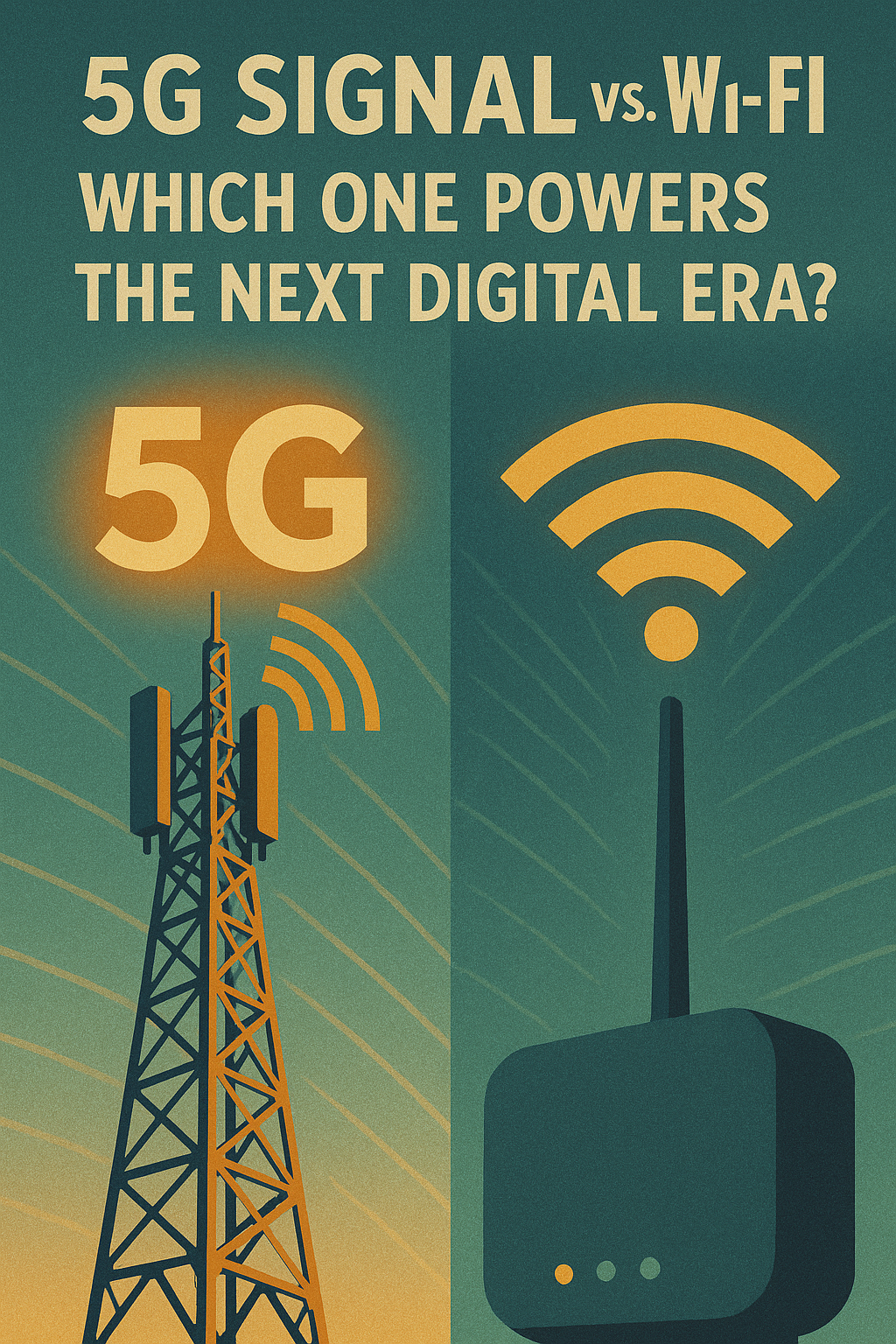
5G Signal

What Is Driving the Need for Next-Gen Connectivity? In our rapidly evolving digital world, the demand for faster speeds, stronger reliability, and seamless connectivity is no longer optional—it’s essential. Whether it’s streaming ultra-high-definition video, working in remote and virtual environments, enabling massive IoT ecosystems, or leveraging real-time applications like augmented reality and autonomous systems, every person and enterprise needs networks that keep up. That’s where technologies like 5G Signal and Wi-Fi 6 come into play. They’re not just upgrades—they’re the infrastructure for the next era of digital life.
Research shows that internet traffic is growing at a staggering annual rate (often ~60 %) because of more devices, more data, and higher expectations. CENGN+2TechTarget+2 Both Wi-Fi 6 and 5G are rising to meet these demands—though they do so with different strengths, trade-offs, and ideal application scenarios. Read More :5 Reasons Why Business Insurance is a Must-Have for Every Entrepreneur
5G Signal: Powerhouse for Mobility and Wide-Area Coverage
When we talk about 5G Signal, we’re referring to the cellular networks based on 3GPP standards (including mid-band, high-band, mmWave, and low band). Some of the most exciting capabilities of 5G Signal include:. Read More :Environmentally Friendly Vehicles: Driving Towards a Sustainable Future
- Ultra-low latency: Under ideal conditions, 5G Signal can achieve latency as low as ~1 millisecond. That means near-instant responsiveness for things like real-time gaming, remote surgery, industrial automation, and vehicle-to-vehicle communication. PatentPC+2Verizon+2
- High spectral capacity and massive device support: 5G Signal supports huge numbers of connected devices per square kilometer, which is crucial for smart city applications and large-scale IoT deployment. Verizon+1
- Broad coverage across cities, rural areas, and especially outdoors: Because of its cellular architecture, 5G Signal can cover much wider rural terrains compared to typical Wi-Fi. However, high-frequency bands (like mmWave) lose strength over distance and through obstacles. Semiconductorinsight+1
But it’s not without its challenges. Deploying 5G Signal infrastructure—especially for higher frequency bands—requires dense small cells, strong backhaul, regulatory permissions, and often substantial investment. Also, spectrum allocation and fragmentation across regions can make device compatibility and rollout complex. Semiconductorinsight+1. Read More : Business Degree Jobs in Digital Marketing: What You Need to Know
Wi-Fi 6: The Indoor Champion and Efficiency Expert

While 5G Signal shines outdoors and in mobility, Wi-Fi 6 (IEEE 802.11ax) is designed to be the high-performance solution inside homes, offices, stadiums, and any place where many devices congregate. Its key advantages include:
- High throughput and better handling of many devices: Wi-Fi 6 offers up to ~9.6 Gbps theoretical peak speeds, and uses technologies such as MU-MIMO (multi-user, multiple input, multiple output) and OFDMA to manage traffic efficiently among many devices. Intel+2CENGN+2
- Lower latency compared to old Wi-Fi standards: Though generally not as low as optimal 5G Signal latency, Wi-Fi 6 can offer latency in the range of 2-10 milliseconds under favorable conditions, especially for indoor usage. That can support VR/AR, gaming, video conferencing, etc. AllTech Insights+2Forest Rock+2
- Energy-efficiency features: Wi-Fi 6 integrates features like Target Wake Time (TWT), which allows devices to sleep during idle times, reducing power consumption for mobile and IoT devices. CENGN+1
However, Wi-Fi 6 has limitations: range is more restricted (walls, interference, obstacles reduce signal strength), it’s more suited to fixed or semi-fixed environments rather than movement, and performance depends greatly on router quality, access point placement, and channel congestion. CENGN+1. Read More :Embracing Remote Work: How Financial Technology is Reshaping Traditional Industries
Head-to-Head Comparison: What 5G Signal Offers vs. Wi-Fi 6
| Aspect | 5G Signal Strengths | Wi-Fi 6 Strengths |
|---|---|---|
| Speed | Theoretical peaks up to ~10 Gbps (especially in mmWave and high spectrum bands) under ideal conditions. Verizon+1 | Similar top theoretical speeds (~9.6 Gbps) for Wi-Fi 6, better in indoor, local networks. Intel+1 |
| Latency | Very low latency (as low as ~1 ms) in good coverage, low interference environments. PatentPC+2Verizon+2 | Low latency in Wi-Fi 6: usually a few milliseconds, sufficient for many interactive apps, though more variable than controlled cellular. AllTech Insights+1 |
| Coverage & Mobility | Excellent for mobility: vehicles, outdoors, large coverage zones. But higher frequencies have less penetration and range. Semiconductorinsight+1 | Excellent indoors, near access points, but mobility across Wi-Fi networks (handoffs) is more challenging. Best for stationary or lightly mobile use. abijita.com+1 |
| Cost & Deployment | Infrastructure cost is high; need many base stations/small cells, regulatory hurdles, spectrum licensing. Semiconductorinsight+1 | Lower relative cost: routers/access points are cheaper; using unlicensed spectrum; existing infrastructure can be upgraded. TechTarget+1 |
| Reliability & Interference | Strong, particularly when properly deployed; network slicing, beamforming, etc., help mitigate interference. But obstacles, weather, line-of-sight issues especially at higher frequencies. PatentPC+1 | In indoor settings, performance can degrade due to interference from neighboring Wi-Fi networks, physical barriers, and crowded frequency bands. RF Wireless World |
Coexistence: Why It’s Not 5G Signal or Wi-Fi 6, But Both
The past few years of research show that 5G Signal and Wi-Fi 6 are less rivals and more partners in powering the next digital age. Some key observations:
- In many scenarios, especially indoors, Wi-Fi 6 will continue to dominate because it’s more cost-effective and less complex to deploy. arXiv
- For mobility, real-time responsiveness, and wide-area coverage, 5G Signal has clear advantages—think autonomous cars, remote robotics, public infrastructure. DTX 360+1
- Shared or unlicensed spectrum (like the 6 GHz band) is enabling more overlap and synergy: both technologies may share portions of spectrum, and both need to coexist while managing interference, security, and performance. arXiv+1
- Use cases in enterprise, smart buildings, healthcare, manufacturing often benefit from hybrid architecture: using Wi-Fi 6 for indoor local connectivity, switching to 5G Signal when moving outdoors or when high mobility is essential. Verizon+1
Challenges Ahead for 5G Signal and Wi-Fi 6
Both technologies, for all their promise, face important hurdles. Awareness of them can motivate innovation and smart deployment. Read More :Healthtech Innovations: Transforming Healthcare at Brilliance Hub
- Spectrum Scarcity & Regulation
Allocating spectrum, especially licensed bands for 5G Signal, is expensive and politically complex. Wi-Fi’s use of unlicensed bands helps, but crowding, interference, and harmonization across regions are ongoing challenges. Semiconductorinsight+1 - Infrastructure Costs & Deployment Complexity
Building dense 5G networks (especially mmWave small cells), providing adequate backhaul, and ensuring indoor coverage require investment and technical expertise. Semiconductorinsight+1 - Device Compatibility & Adoption
For both 5G Signal and Wi-Fi 6, the ecosystem of devices needs to support the technology. Older devices may not support features like mmWave, TWT, or WPA3, limiting benefit. CENGN+1 - Interference, Signal Penetration & Range Limitations
High-frequency 5G Signal bands are easily attenuated by walls, foliage, and even weather. Similarly, Wi-Fi 6 in crowded indoor spaces can suffer when many access points overlap or channels are saturated. abijita.com+1 - Security & Privacy Concerns
As networks become more complex, with shared spectrum and mixed technologies, there are risks: unauthorized access, rogue base stations, cross-layer threats, etc. Research is actively exploring secure frameworks for coexistence. arXiv+1
About the Author